

Do you have Questions?
We have 50+ roll formers serving automotive, agricultural, transportation, construction, material handling, storage, medical, furniture, electrical, recreation, and many other markets.
MP Metal Products has experience forming a variety of metals, including stainless steel, galvanized steel, aluminized steel, aluminum, copper and pre-painted coils. Gages range from .005" to .165", and widths from 1/2" to 48" in various alloys, tempers, and finishes, in simple or complex shapes.
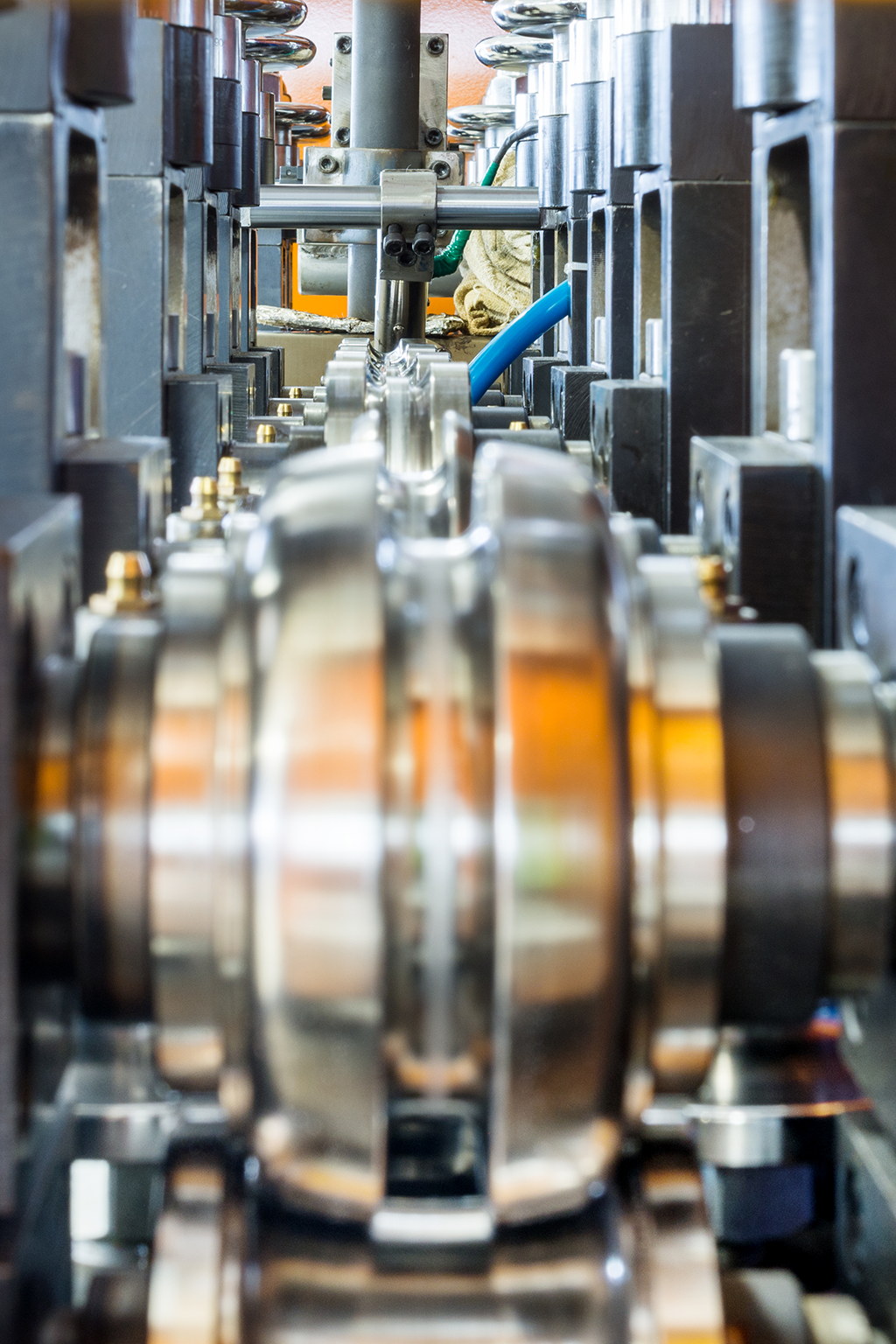
We process coils which come in rather large offerings. This differs from sheets where small lots can be purchased. We need coils to progressively form profiles that just does not work with a sheet.
If tools to make the profile already exist, then the typical minimum to economically purchase coil is in the vicinity of 5,000 lineal feet. If the profile is new, or requires tooling, the economic threshold is often in the vicinity of 30,000 to 50,000 lineal feet to help justify the investment in custom roll form tooling.
If tools to make the profile already exist, then the typical minimum to economically purchase coil is in the vicinity of 5,000 lineal feet. If the profile is new, or requires tooling, the economic threshold is often in the vicinity of 30,000 to 50,000 lineal feet to help justify the investment in custom roll form tooling.
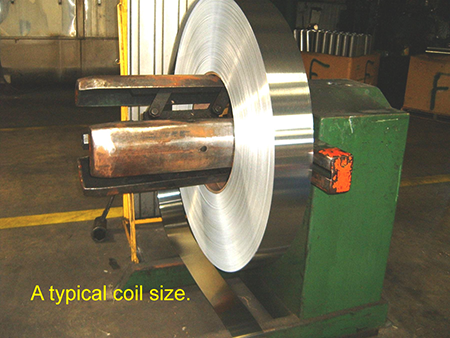
A typical coil size
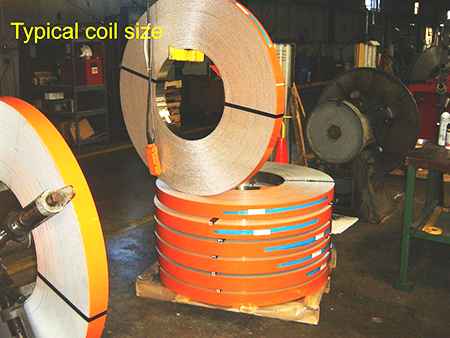
A typical coil size
This is a good place to check the material characteristics, such as ductility and malleability.
Most metals that are available in coil, sheet or strip can be roll formed. We commonly roll form shapes in aluminum, steel (cold rolled, hot-rolled and galvanized), stainless and copper, to mention a few. Some parts are also made from pre-coated material.
Most metals that are available in coil, sheet or strip can be roll formed. We commonly roll form shapes in aluminum, steel (cold rolled, hot-rolled and galvanized), stainless and copper, to mention a few. Some parts are also made from pre-coated material.
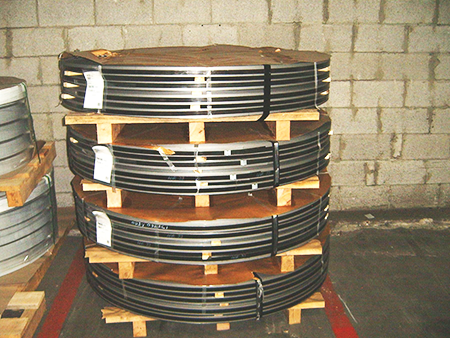
Coils of hot-rolled steel
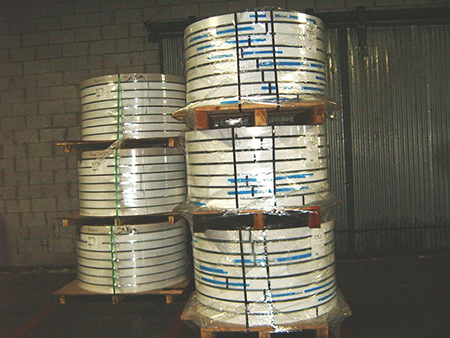
Coils of pre-painted aluminum
Small lots of prototypes are difficult to make.
First, minimum coil purchase often represent lots around 5,000 lineal feet.
Second, we use "hard" tooling that is specifically designed to make the actual profile on a print. Sometimes the width may be flexible, but the height is constant. Small lots may be available as the tooling is tested and proven before the cut-off dies is finished, but special arrangements have to be made in the planning process.
Third, if the profile is in development, if possible, it may be more economical to opt for Press Brake samples, or an Aluminum Extrusion, or possibly 3D Printing.
When discussing tolerances it is very helpful to work from a dimensioned Print. Yes, we have actually used sketches and napkins over the years, but that is more the exception. A thorough Print review helps define the requirements and expectations. Begin with:
Generally Roll Forming produces shapes with tolerances more consistent than Press Braking.
Common tolerances are:
Holes and slots often elongate if punched prior to forming. If location is critical that may mean they should be done after forming.
Depending on the requirement, overall lengths can be controlled with several methods:
If you can identify what performance is really needed it will help steer the process and controls.
- What is the Fit, Form and Function?
- What tolerance do you need?
- Where?
- X.XXX = + / - 0.010"
- X.XX = + / - 0.030"
- X.X = + / - 0.060"
- Fractions = + / - 1/32"
- Angles = + / - 1 degree
Depending on the requirement, overall lengths can be controlled with several methods:
- Flags provide about + /- 1/8" accuracy
- Encoders offer about + / - 1/32" accuracy
- Pick-up arms provide about + / - / 64"
It is helpful for the customer to provide as much packaging guidance as possible. We have many packaging alternatives ranging from corrugated boxes, to standard Gaylords, to skids, to wooden crates. The size and weights are tailored to fit within the customers' constraints for receiving and handling. Sometimes protective paper or poly film are involved. Other items are bound in small bundles with shrink wrap. Let us know what works best for your application.
We have equipment that can form Profiles that begin with flat coil up to 48" wide. We also have run parts that used coil as narrow as ½". Other considerations come into play if there are holes, slots, miters and so on.
The equipment we operate can roll form metal thicknesses from 0.005" up to 0.165", of course depending on the profile. Generally speaking, simpler shapes can use thicker material, while more complex shapes trend to thinner material to accommodate tight hems, fold-back legs, and other features. The hardness and coating of the material must also be taken into consideration to avoid fracturing and crazing on tight radii.
The specific feature being requested merits a detailed print review. The tolerances for location and size may have a major impact. Pre-punched Holes that are formed too close to a formed radius usually distort. Pre-punched holes may also elongate if they occur prior to the roll forming pressure. It helps to thoroughly discuss the details before hard tooling is built. There may be requirements that are better suited to post-punching holes, slots and so on.
And on a related note, markings can also be included to identify production dates as with a stamped imprint or a laser-printed identification label. Detailed print reviews and customer discussions are very helpful.
First of all, nothing is in stock. Everything is made to order. Lead-times vary but are often in the 2-to-8-week time frame depending on material availability and equipment schedules. It works best to contact us to discuss what common profiles may be available.
Roll formed metal parts are usually cheaper to manufacture than cast or machined parts.
Contact MP Metals today and let us answer your questions about roll forming and maybe we can save your company some money, too.